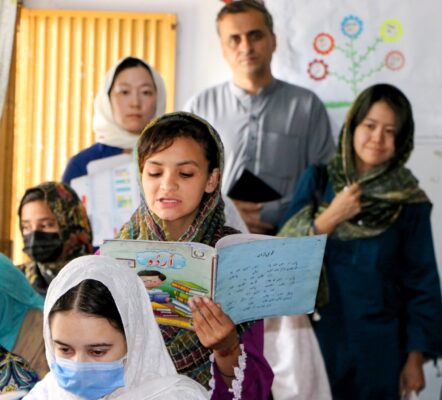
Establishment of ALP centers/ Community awareness via PTCs/Formation of VNF
Funded By:
Project Brief
SRSP, with financial and technical support from JICA, is implementing an Accelerated Learning Programme (ALP) for out-of-school children (OOSC) from Afghan refugee and host communities in Mansehra and Haripur. The programme aims to provide a second-chance education pathway for children aged 11–17 years who have either never attended school or dropped out early—particularly adolescent girls facing social, economic, and mobility barriers. A total of 30 ALP Centers (15 in each district) are planned under the initiative. These centers use the Package “D” curriculum, which offers a fast-track, non-formal education equivalent to Grades 6 and 7. The programme is designed to help learners transition smoothly into mainstream schools and reduce learning inequities in high-refugee-density areas.
Objective
The objective of the Accelerated Learning Programme (ALP) is to provide out-of-school children, particularly adolescent girls from Afghan refugee and host communities in Mansehra and Haripur, with a second-chance, fast-track education pathway. The programme aims to equip learners aged 11–17 with foundational knowledge and skills through a non-formal curriculum (Package “D”), enabling them to re-enter mainstream schooling and overcome social, economic, and mobility barriers to education.
Progress to Date
During the reporting period, SRSP successfully completed all foundational activities, enabling the programme to move efficiently into the teaching and learning phase. All project staff were oriented on programme objectives, beneficiary selection criteria, and the household survey tools. A detailed Need Assessment / Household Survey was carried out covering 1,200 households, through which 2,500 children were identified, including 1,788 out-of-school children who now form the primary pool for enrolment into ALP Centers.
Following community consultations, SRSP identified and finalized 30 suitable learning spaces for ALP Centers (both treated and control groups), and established 15 functional ALP Centers under the treated group. 15 facilitators—selected based on qualifications, experience, and community acceptance—were trained on Package “D,” homework assignment methods, and classroom management.
A Voluntary Network Formation (VNF) was established in each centre to support enrolment drives, community mobilization, and learner retention. Additionally, SRSP developed and submitted all required baseline/endline tools—including DCTE academic assessment tools, soft-skills modules, and a 12-item Grit Scale—to JICA for approval.
Enrolment targets were successfully met, with 527 students enrolled (against the target of 525). All centers were provided with teaching-learning materials, including books, teacher guides, notebooks, and baseline assessment tools. Baseline assessments were completed for students enrolled in ALP Centers as well as those in control schools, ensuring robust evidence for future impact analysis.
Orientation sessions on NFEMIS were conducted to strengthen data management and reporting systems.